


89 / 103
Broomfield - St Mary
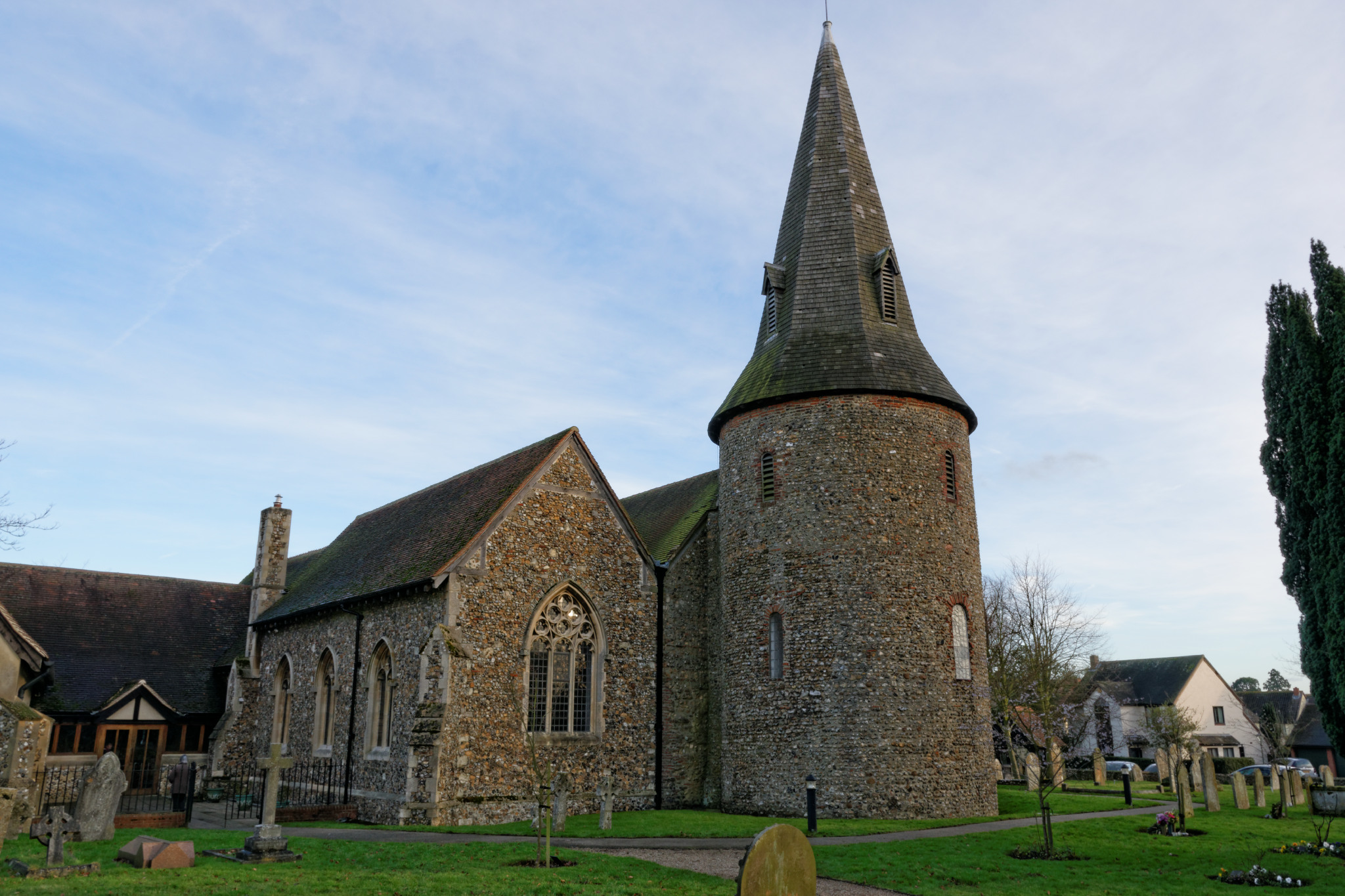
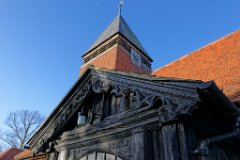
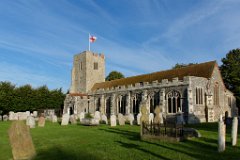
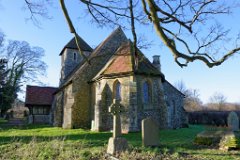
Originally a Norman church, but much altered over the years. The Norman tower is built from successive course of flints brought in from the fields. About 9 courses were laid per year. The church was fully restored in Victorian times when the north aisle was built. Inside, the font of Purbeck marble is Norman.
There is some folklore about the site chosen for the church. The orginal intention was to build it at the top of New Barn Lane, and stones were assembled there. But at night, a dragon would move the stones to the the Green. Finally, people gave up fighting the dragon and built the church where it stands today. In a field at the top of New Barn Lane there is a depression in the ground called Dragon's Foot in the tithe maps
Some of the folklore about the church is rooted in its pagan beginnings. Among the flint and Roman bricks of the South wall is a projecting puddingstone, or mass conglomerate. This feature suggests a Christianised site according to the edicts of Pope Gregory to assimilate pagan practices into early Christianity. As at Alphamstone in Essex and Pewsey in Wiltshire it has an unusual stone protruding (and prominently visible) in its foundations. Across the lane from the Church of St Mary there is a pond fed by both a stream and several springs - one of the houses (parts of which are medieval) opposite the church has a rivulet running under the paving stones in its cellar. It is said that the two sarsens in front of the church gate were originally in the stream that runs close to the church. The springs and stream, together with evidence of a Roman villa and the unusual black puddingstone in the church foundations, perhaps indicate that the site was sacred and pre-dates both Christianity and the Roman occupation.